Part 2: The Patterns You Didn’t Realize You Built

Most people think experience is just a collection of moments.

Jobs. Titles. Wins. Failures.

A timeline.

But that’s not where the real value lives.

The value is in the patterns.

Think about this.

You’ve handled difficult conversations more times than you can count.
You’ve stepped into uncertainty and figured it out.
You’ve seen things go wrong, and you’ve learned how to respond.

Not once.

Over and over again.

That repetition matters.

Because repetition creates patterns.
And patterns create judgment.

Here’s the problem.

Most people never stop long enough to see those patterns.

They move from role to role, year to year, solving problems, leading teams, making decisions.

But they never step back and ask:

What do I consistently do well, no matter the environment?

That question changes everything.

Because when you answer it honestly, you start to see something different.

You’re not just someone who “worked in operations” or “led a team” or “built a career.”

You’re someone who:

  • Brings calm into chaotic situations

  • Sees risks before others notice them

  • Builds trust quickly with people who are skeptical

  • Turns ambiguity into action

Those are patterns.

And those patterns are transferable.

This is where most people underestimate themselves.

They assume their value is tied to a specific role, industry, or title.

It’s not.

It’s tied to how they think, how they decide, and how they show up when things get hard.

That’s what people actually pay for.

If you’re thinking about what’s next, this is the work.

Not rewriting your resume.

Not chasing something completely new.

But identifying the patterns that have been there all along.

Try this.

Instead of asking “What have I done?”
Ask:

“What problems do I consistently solve, regardless of the situation?”

Write down five.

Then look for the common thread.

That’s where your next chapter starts.

In Part 3, we’ll take this a step further.

Because once you see your patterns, the next question becomes:

How do you position them so others immediately understand your value?

That’s where things start to move.

Part 1: You Are Not Done Yet

Why experience is the most undervalued asset in the modern economy

For most of your career, your value was obvious.

You had a title.
You ran a division.
You led teams.
You made decisions with real stakes attached.

Your role created the structure through which your judgment flowed.

Then one day that structure changes.

Maybe you retired.
Maybe the company restructured.
Maybe you chose to step away.

Suddenly something strange happens.

All that experience remains inside you, but the world seems unsure what to do with it.

That’s because most of our culture still runs on an outdated script:

Work hard.
Build a career.
Retire.
Step aside.

That script made sense in an industrial economy where work was physical and bodies wore out.

But it makes very little sense in a knowledge economy where the most valuable asset isn’t strength.

It’s judgment.

Experience Is an Appreciating Asset

Think about what the last 30 or 40 years of your career actually produced.

You didn’t just accumulate knowledge.

You built pattern recognition.

You’ve seen markets rise and fall.
You’ve watched strategies succeed and collapse.
You’ve navigated politics, crisis, and ambiguity.

You know where the cliffs are.

And that kind of judgment compounds.

You can see the difference immediately when experienced professionals enter a room.

They ask better questions.

They anticipate problems earlier.

They sense dynamics others don’t even notice yet.

That advantage comes from four forms of wisdom that only time produces:

Pattern Recognition

You’ve seen cycles repeat.
When others are seeing a problem for the first time, you’ve already watched the movie before.

Exception Memory

You remember when the rule broke.

Those rare situations that textbooks never cover often matter most when the stakes rise.

Error Recovery

You’ve lived through failure.

You know how to stabilize a situation when plans collapse.

Calm becomes a capability.

Context Sense

You’ve learned to read incentives, politics, timing, and human emotion.

Technology evolves quickly.

Human behavior changes slowly.

Experience teaches you to read the room.

Titles Expire. Judgment Compounds.

One of the biggest mistakes experienced professionals make is assuming their value lived inside their title.

It didn’t.

Your title was simply the delivery system.

The real asset was the judgment behind the decisions you made.

And that asset does not expire when your role changes.

In many ways, it becomes more valuable.

In a world where information is abundant and AI can generate answers instantly, the scarce resource isn’t knowledge.

It’s discernment.

Algorithms can produce data.

They cannot replicate seasoned judgment.

The ability to interpret complexity, weigh competing incentives, and make decisions under uncertainty is exactly what organizations need most.

Which means something important.

You didn’t age out.

You aged into an advantage.

The Work Now Is Making Your Wisdom Legible

Most experienced professionals possess enormous insight that never leaves their head.

They share it occasionally in conversations.

They mention it in meetings.

But they rarely extract it, structure it, and deploy it intentionally.

That’s the real opportunity of this stage of life.

Not retiring.

Mining what you know.

Over the next few articles in this series, I’m going to show you how to do exactly that.

We’ll explore:

• How to extract lessons from defining career moments
• How to turn experience into teaching stories
• How to package wisdom into services others can buy
• How to build an independent work life around your judgment

Because the world doesn’t need another expert hoarding knowledge.

It needs guides who can light the path for others.

And the people best positioned to do that are those who have already walked the road.

You are not done yet.

You’re just entering the chapter where your experience becomes its most valuable.

PART 2: Reinvention Is Not Reinvention, It’s Distribution

Let’s get honest about something.

When many experienced professionals talk about “reinvention,” what they really mean is, “I don’t want to feel irrelevant.”

That framing is wrong.

Reinvention is not about relevance.

It’s about distribution.

As I wrote in the manifesto:

“Experience alone is dormant wealth.”

Your wisdom doesn’t disappear when you leave a corporate role.

What disappears is the distribution channel.

Your title was a distribution channel.
Your team was a distribution channel.
Your formal authority was a distribution channel.

Remove those, and the capital remains.

But without infrastructure, it doesn’t flow.

My Own Six-Week Experiment

When I transitioned out of full-time corporate leadership, I did not have a master blueprint.

I wish I could say I had a perfectly mapped Encore strategy. I didn’t.

What I had were small experiments.

A six-week consulting pilot.
A few advisory conversations.
A speaking engagement that stretched me.

None of it felt like a “big reinvention.” It felt tentative.

But here’s what I learned:

You cannot think your way into a new identity.

You have to try it on.

That consulting pilot wasn’t dabbling. It was market research.

Does this wisdom find buyers?
Does this contribution energize me?
Is this the right channel for my capital?

Reinvention is simply building new infrastructure for existing assets.

And when you shift your mindset from “Who am I now?” to “Where should my wisdom flow?” everything changes.

The Multiplication Effect

Here’s the paradox that surprised me most.

When you contribute your wisdom, you don’t lose it.

You multiply it.

As I wrote:

“Sharing wisdom doesn’t divide it. It compounds it.”

Every time I mentor someone, I learn something.
Every time I teach a framework, I refine it.
Every time I advise a founder through uncertainty, I add another data point to my pattern library.

Contribution creates two returns:

  1. Immediate value, income, impact, connection

  2. Compounding value, learning, refinement, reputation

This is not about staying busy.

It’s about leverage.

One transformative mentorship is worth more than ten surface consultations.

One strategic advisory role is worth more than scattered activity.

The goal is not volume. It’s depth.

And depth is where experienced professionals shine.

In Part 3, I want to talk about the highest expression of the Wisdom Dividend, legacy. Not the sentimental version. The strategic one.

Building Digital Confidence: Why Visibility Is Oxygen for Your Second Act

There was a time when reputation spread through word of mouth, introductions, and handshakes. Today, it happens through pixels. In the digital age, visibility isn’t a luxury or a “nice to have.” It’s oxygen. Without a visible presence online, even the most seasoned professionals risk fading into the background of a noisy world.

Yet for many in their encore careers, the digital shift brings a quiet hesitation, a sense of tech shame. The thought of posting videos, managing LinkedIn, or experimenting with AI tools can feel like stepping into a foreign land where the rules are unwritten and everyone else seems to speak the language fluently.

Here’s the truth: no one is born digitally confident. Confidence comes through experimentation, not perfection.

From Tech Fear to Digital Play

The fastest way to overcome “tech shame” is to reframe it as “tech play.” Treat digital tools the way you once treated new leadership challenges, something to explore, not master overnight. Every platform you test, every post you share, every mistake you make builds skill and self-assurance.

Remember your first time leading a major project? You didn’t wait until you knew everything. You learned by doing. The same applies here. Start small, stay curious, and remind yourself that digital fluency is a practice, not a personality trait.

Step One: Refresh Your Profile

Your digital presence begins with your online identity. A strong profile doesn’t brag, it clarifies.

Start with LinkedIn. Update your headline to reflect what you do now, not what you used to do. Shift from titles to transformation. Instead of “Former VP of Operations,” try “Helping leaders simplify complex systems for scalable growth.”

Add a recent photo that reflects your current energy and a banner image that signals your new direction. Rewrite your summary in the first person. Share why you do what you do, who you help, and the impact you create.

A modern, story-driven profile positions you as active and relevant. It tells potential clients and collaborators that you’re not retired, you’re re-engaged.

Step Two: Create a Simple Content Rhythm

Consistency builds credibility. You don’t need to post daily to make an impact. A simple cadence, one post a week, one video a month, one direct message a day is enough to build traction.

  • One post a week: Share an insight, story, or lesson learned from your decades of experience. Keep it conversational. Invite reflection, not just attention.

  • One video a month: A short video, just you speaking authentically to the camera, humanizes your expertise. People trust faces more than logos.

  • One message a day: Send a quick note of appreciation or curiosity to someone in your network. Digital visibility is built as much through private conversations as public content.

Over time, these small habits compound into a powerful online presence.

Step Three: Engage, Don’t Just Broadcast

Social media isn’t a megaphone, it’s a conversation. Comment on others’ posts with thoughtfulness. Share their ideas with gratitude. Join discussions in professional groups. When you show up as a participant instead of a promoter, people begin to notice.

Your voice gains weight not from volume, but from value. Engagement creates community, and community creates opportunity.

Step Four: Partner with Technology

The digital tools available today can amplify your message without diluting your authenticity. AI, for example, isn’t here to replace your wisdom, it’s here to extend it.

Use AI to brainstorm content ideas, refine your writing, or generate outlines for presentations. Let automation handle routine tasks like scheduling posts or managing emails. But always add your personal touch. The human voice, your humor, your insight, your story, is what makes your digital presence magnetic.

As the saying goes: Don’t chase trends, choose tools that express your voice.

Small Habits, Big Confidence

Confidence doesn’t arrive in a lightning bolt, it grows from repetition.

  • Record short voice memos of ideas and turn them into posts.

  • Spend ten minutes each morning reading and commenting on your feed.

  • Join one online community where your peers gather.

  • Celebrate progress instead of perfection.

Each digital step strengthens your professional identity. You’ll find that as your comfort increases, opportunities start to flow toward you, clients who found you online, invitations to collaborate, podcast interviews, or speaking engagements that wouldn’t have appeared otherwise.

The New Currency of Confidence

In this era, digital literacy equals professional confidence. It signals relevance, adaptability, and courage, the very traits that make encore professionals stand out. When people see you showing up online with clarity and consistency, they don’t see someone “trying to keep up.” They see a leader who’s evolving.

You don’t need to master every platform. You don’t need to go viral. You just need to be findable, relatable, and unmistakably you.

Your Next Step

Choose one small action this week to build digital confidence. Maybe it’s rewriting your LinkedIn headline, recording a short video, or commenting on someone else’s post with genuine curiosity.

Each act is a brick in the digital foundation of your second act.

Because in the modern world, visibility isn’t vanity, it’s vitality. And the moment you begin showing up, you stop fading into the feed and start shaping the conversation.

A Clearer Way to Think About What’s Next

There’s a moment many experienced professionals reach that’s hard to explain out loud.

You’re not burned out.
You’re not done.
But the old answers don’t quite fit anymore.

The question of “what’s next” keeps tapping you on the shoulder. Quietly. Persistently.

And if you’re honest, you might be circling that question instead of really engaging it. Not because you don’t care, but because most of the advice out there feels either vague or wildly disconnected from the reality of decades of experience.

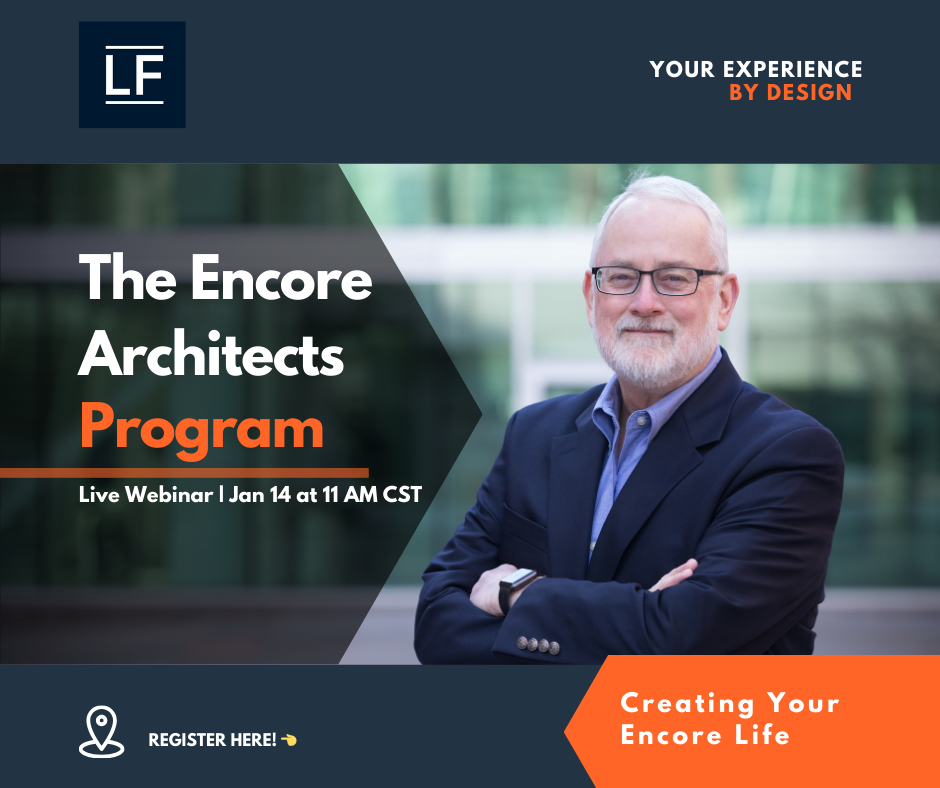
That’s exactly why I’m hosting a free live webinar on Wednesday, January 14 at 11:00 AM CST | 12:00 PM EST.

Why Most People Drift Into Their Next Chapter

Here’s the uncomfortable truth.
Most people don’t design their next chapter. They drift into it.

Not because they lack motivation or ambition, but because no one ever showed them a different way to think about transition. Retirement becomes the default. Consulting becomes the fallback. “I’ll figure it out later” becomes the plan.

But an Encore Life deserves more intention than that.

Designing an Encore, Not Stumbling Into One

This live webinar introduces the core ideas behind The Encore Architects Program, a framework built specifically for experienced professionals who want to use their experience as an advantage, not something to downplay or apologize for.

We’ll talk about what it actually means to design your next chapter, instead of reacting to it.

In the session, we’ll cover:

  • Why drifting is the default, and how to avoid it

  • How to think about an Encore Life as something you actively design

  • The mindset and structure behind the Encore Architects approach

  • What the Encore Architects Founding Cohort includes, and who it’s best suited for

This is not a motivational talk. There are no platitudes here.

It’s a working session designed to help you find clearer language for where you’re headed and decide, with more confidence, what deserves your energy next.

Is This Webinar for You?

This session is for you if:

  • You’ve built a meaningful career and don’t want to simply “wind it down”

  • You know you still have value to offer, but want to be more intentional about how

  • You’re tired of vague advice and ready for a clearer framework

If that sounds familiar, I’d love to have you join us live.

👉 Register here to save your spot 👈
The webinar is free, live, and space is limited.

I’d love to see you there!

Your Encore Career Needs More Than Inspiration. It Needs Implementation.

After 40 years leading teams at John Deere, I learned that good ideas die in the gap between knowing and doing. You can attend every workshop, read every book, and map out your perfect encore career, but without systematic implementation, you’re just planning.

That’s why I built LynnAI Pro.

The Free Version Got You Thinking. Now It’s Time to Build.

The free LynnAI tool helps professionals explore the “what” and “why” of encore careers. Thousands have used it to clarify their thinking, identify their strengths, and understand what’s possible after corporate life. It’s designed for discovery.

LynnAI Pro is designed for execution.

It’s the difference between exploring career transition and actually completing one. Between contemplating your value proposition and having one ready to present. Between thinking about your portfolio career and building it, week by week.

What LynnAI Pro Actually Does

LynnAI Pro combines my decade of coaching methodology—distilled from my own 10-year reinvention plus hundreds of client conversations—with AI-powered implementation support. Here’s what that means in practice:

Weekly Action Plans, Not Generic Advice. You don’t need another pep talk about “finding your purpose.” You need a specific action for this week: who to contact, what to write, where to test your offer. LynnAI Pro delivers timed exercises with clear deliverables.

Framework-Driven Transformation. The tool is built on proven frameworks: G.L.E.A.N. for skill translation, S.T.O.R.Y. for narrative development, and the Offer Ladder methodology for revenue generation. These aren’t theoretical models. They’re structures that produced results for executives transitioning from Fortune 500 roles into portfolio careers.

Progress Tracking That Measures What Matters. LynnAI Pro tracks specific transformation markers: network conversations completed, value propositions tested, revenue streams activated. No vague “journey” language—just quantifiable forward momentum.

On-Demand Coaching Without Calendar Coordination. Access strategic guidance at 11 PM on Tuesday or 6 AM on Sunday. LynnAI Pro doesn’t replace human coaching, but it extends it, giving you implementation support between sessions or when you need immediate clarity on next steps.

Who Gets Results With LynnAI Pro

This tool works for professionals who:

  • Have proven executive or leadership experience but need systematic approaches to career reinvention

  • Want methodology over motivation—you’re past needing inspiration

  • Value evidence-based frameworks that show clear cause-and-effect

  • Need accountability structures that track actual progress, not feelings

  • Prefer strategic guidance they can implement immediately

One client built a portfolio combining board work, mentoring, and part-time teaching—all generating income while maintaining schedule flexibility.

The Implementation Advantage

Here’s what differentiates professionals who successfully design encore careers from those who stay stuck in transition paralysis:

Successful transitioners follow systematic processes. They translate experience into modern contexts. They test offers quickly. They build networks strategically. They track progress quantitatively. They make decisions based on evidence, not emotion.

LynnAI Pro is built specifically to support that implementation mindset.

At 75, I’m still experimenting, still launching, still refining my own portfolio. LynnAI Pro represents my current answer to the question I’ve been working on for a decade: how do experienced professionals systematically design encore careers that generate impact and income?

The answer isn’t more thinking. It’s structured action.

Beyond the Free Tool

If you’ve used the free LynnAI and found value in the exploration, LynnAI Pro is your next step. It takes the clarity you’ve developed and converts it into concrete actions with specific timelines.

This isn’t about finding yourself. You already know who you are. This is about building what comes next—with the same strategic thinking and execution discipline that made you successful in your primary career.

Your decades of accumulated wisdom deserve better than a default retirement. They deserve intentional design. LynnAI Pro provides the systematic framework to build that design.

Ready to move from exploration to execution? LynnAI Pro launches in December alongside structured coaching programs designed to complement the AI tool with human expertise.

Because your encore career shouldn’t just be possible. It should be inevitable.

Sign up for the LynnAI Pro Waitlist

or try the free version here!

How My Team of 19 AI Assistants Helps You Get a Clearer, Faster Encore Plan

If you’re a high-achieving professional in your 50s or 60s, you may be asking a question that’s both exciting and unsettling:

What’s next for me and how do I make it meaningful and financially smart?

I coach executives and professionals who are stepping into an encore chapter, often after decades of success. And here’s something I’ve learned: reinvention isn’t just about choosing a new job or starting a business. It’s about rebuilding identity, designing a life that fits now, and creating income you can feel good about.

To support you at a high level, I don’t rely on willpower and late nights. I use a team of 19 AI assistants (including Claude, ChatGPT, CoachVox, Sintra, Whisper Flow, and Descript) to handle the behind-the-scenes work so our time together stays focused on what matters most: you.

This is not about replacing human coaching. It’s about giving you a coaching experience that’s more organized, more personalized, and more actionable.

What this means for you (the client)

When I use AI well, you get a better outcome, because I can spend less time on admin and more time helping you think clearly and move forward.

Here’s what you can expect.

1) More clarity, faster

You don’t need more information. You need the right structure.

My AI tools help me:

  • Capture your goals, constraints, and preferences clearly

  • Organize patterns I’m hearing across our conversations

  • Turn big, emotional questions into practical next steps

So instead of circling the same doubts for months, you build momentum.

2) A plan that feels personal, not generic

You’ve spent decades building expertise. Your encore path should reflect that.

I use tools like Claude and ChatGPT to help me explore multiple options quickly—then I apply my human judgment and coaching experience to shape what fits you.

That means:

  • More tailored ideas

  • Better language for your story and positioning

  • Clearer decisions about what to pursue (and what to ignore)

3) Your ideas captured, even when you’re busy

Many of my clients have their best insights while walking, traveling, or in the space between meetings.

With Whisper Flow, I can quickly capture and convert spoken insights into usable notes and next steps. The benefit for you: you don’t lose the good stuff.

4) Stronger follow-through between sessions

Reinvention doesn’t happen in a single conversation. It happens in the week after.

My systems help me:

  • Send clearer summaries and action steps

  • Provide templates and prompts so you’re not starting from scratch

  • Keep your progress organized so you can see what’s working

You stay focused, and you don’t have to hold everything in your head.

5) More value without inflating the price

Here’s the part most people don’t see.

To deliver this level of support, many coaches would need a bigger human team—and that cost gets passed on to clients.

Instead, I use a lean, modern setup: my AI team of 19 costs under $1,000/month. That helps me keep my business efficient and invest in the tools and systems that improve your experience—without turning coaching into a luxury reserved for a few.

A quick look at the tools (and what they do for you)

I’ll keep this simple. These tools are not the point—your results are.

  • Claude: helps me create clear frameworks and long-form guidance tailored to your situation

  • ChatGPT: helps me generate options, language, and fast drafts we can refine together

  • CoachVox: helps me keep my coaching approach consistent and aligned with my philosophy

  • Sintra: supports my workflow so your experience feels organized and responsive

  • Whisper Flow: turns voice notes into usable insights and action steps

  • Descript: helps me produce and repurpose audio/video content so you can learn in the format you prefer

What AI can’t do, and why that matters

AI can’t replace the most important parts of this work:

  • The ability to hold space for uncertainty

  • The discernment to challenge you at the right moment

  • The wisdom to help you separate fear from truth

  • The human connection that makes change sustainable

That’s my job.

AI simply makes it easier for me to show up prepared, present, and focused on you.

If you’re considering an encore chapter, START HERE!

If you’re feeling the pull toward something new, here’s a simple place to begin:

  1. Identify what you’re no longer willing to do

  2. Name what you want more of (impact, freedom, income, meaning)

  3. Choose one small experiment you can run in the next 14 days

If you’d like a sounding board, I’m happy to help.

A Next Step

If you want, reply with:

  • What you’re leaving (or considering leaving)

  • What you want your encore chapter to feel like

  • The biggest decision you’re stuck on right now

I’ll share a few thoughtful next steps and a simple way to move forward.