
You Are Not Done Yet

Why experience is the most undervalued asset in the modern economy

For most of your career, your value was obvious.

You had a title.
You ran a division.
You led teams.
You made decisions with real stakes attached.

Your role created the structure through which your judgment flowed.

Then one day that structure changes.

Maybe you retired.
Maybe the company restructured.
Maybe you chose to step away.

Suddenly something strange happens.

All that experience remains inside you, but the world seems unsure what to do with it.

That’s because most of our culture still runs on an outdated script:

Work hard.
Build a career.
Retire.
Step aside.

That script made sense in an industrial economy where work was physical and bodies wore out.

But it makes very little sense in a knowledge economy where the most valuable asset isn’t strength.

It’s judgment.

Experience Is an Appreciating Asset

Think about what the last 30 or 40 years of your career actually produced.

You didn’t just accumulate knowledge.

You built pattern recognition.

You’ve seen markets rise and fall.
You’ve watched strategies succeed and collapse.
You’ve navigated politics, crisis, and ambiguity.

You know where the cliffs are.

And that kind of judgment compounds.

You can see the difference immediately when experienced professionals enter a room.

They ask better questions.

They anticipate problems earlier.

They sense dynamics others don’t even notice yet.

That advantage comes from four forms of wisdom that only time produces:

Pattern Recognition

You’ve seen cycles repeat.
When others are seeing a problem for the first time, you’ve already watched the movie before.

Exception Memory

You remember when the rule broke.

Those rare situations that textbooks never cover often matter most when the stakes rise.

Error Recovery

You’ve lived through failure.

You know how to stabilize a situation when plans collapse.

Calm becomes a capability.

Context Sense

You’ve learned to read incentives, politics, timing, and human emotion.

Technology evolves quickly.

Human behavior changes slowly.

Experience teaches you to read the room.

Titles Expire. Judgment Compounds.

One of the biggest mistakes experienced professionals make is assuming their value lived inside their title.

It didn’t.

Your title was simply the delivery system.

The real asset was the judgment behind the decisions you made.

And that asset does not expire when your role changes.

In many ways, it becomes more valuable.

In a world where information is abundant and AI can generate answers instantly, the scarce resource isn’t knowledge.

It’s discernment.

Algorithms can produce data.

They cannot replicate seasoned judgment.

The ability to interpret complexity, weigh competing incentives, and make decisions under uncertainty is exactly what organizations need most.

Which means something important.

You didn’t age out.

You aged into an advantage.

The Work Now Is Making Your Wisdom Legible

Most experienced professionals possess enormous insight that never leaves their head.

They share it occasionally in conversations.

They mention it in meetings.

But they rarely extract it, structure it, and deploy it intentionally.

That’s the real opportunity of this stage of life.

Not retiring.

Mining what you know.

Over the next few articles in this series, I’m going to show you how to do exactly that.

We’ll explore:

• How to extract lessons from defining career moments
• How to turn experience into teaching stories
• How to package wisdom into services others can buy
• How to build an independent work life around your judgment

Because the world doesn’t need another expert hoarding knowledge.

It needs guides who can light the path for others.

And the people best positioned to do that are those who have already walked the road.

You are not done yet.

You’re just entering the chapter where your experience becomes its most valuable.

PART 3: Legacy Is Not What You Leave Behind, It’s What You Transmit

When people hear the word legacy, they often think of plaques. Endowments. Buildings with their name on them.

That’s not what I’m talking about.

The highest expression of the Wisdom Dividend is transmission.

As I wrote:

“Legacy isn’t what you leave behind when you die. It’s what you distribute while alive and set up to keep compounding after you’re gone.”

That line took me a while to earn.

A Moment I’ll Never Forget

A few years ago, a former mentee called me.

She was leading through her first real crisis. Board pressure. Internal conflict. High stakes.

She said, “I heard your voice in my head. You once told me that when the room gets loud, slow down the pace of your own speech. It changes the energy.”

She did it.

The meeting shifted.

That’s legacy.

Not because I was there.
But because something I transmitted traveled forward without me.

That’s compounding.

When someone applies your framework, and then teaches it to someone else, your capital continues to generate returns.

Financial wealth stops compounding when you die.

Wisdom wealth can compound indefinitely.

Why This Moment Matters

We are living through a hinge point.

Artificial intelligence can summarize, draft, analyze. It can replicate knowledge.

It cannot exercise judgment.

It cannot read political nuance in a room.
It cannot sense when a leader is about to make a mistake rooted in ego.
It cannot mentor someone through failure with steady presence.

In a world drowning in information, discernment becomes the premium asset.

Your Wisdom Dividend is not threatened.

It is amplified.

But only if you activate it.

The Encore Architects Invitation

This is exactly why I created the Encore Architects Founding Cohort.

Not as a coaching program.

As infrastructure.

A place where experienced professionals can:

  • Mine 40 years for gold

  • Clarify their Encore vision

  • Rewrite their narrative from “retiring from” to “transitioning to”

  • Build a 90-day runway for strategic experiments

Because drifting into retirement is not a strategy.

Designing your Encore Life is.

You are not done.

You are sitting on appreciating capital.

The compounding is just beginning.

The only question is whether you’ll collect your dividend.

And I believe the best returns are still ahead.

Not despite your age.

Because of it.

PART 2: Reinvention Is Not Reinvention, It’s Distribution

Let’s get honest about something.

When many experienced professionals talk about “reinvention,” what they really mean is, “I don’t want to feel irrelevant.”

That framing is wrong.

Reinvention is not about relevance.

It’s about distribution.

As I wrote in the manifesto:

“Experience alone is dormant wealth.”

Your wisdom doesn’t disappear when you leave a corporate role.

What disappears is the distribution channel.

Your title was a distribution channel.
Your team was a distribution channel.
Your formal authority was a distribution channel.

Remove those, and the capital remains.

But without infrastructure, it doesn’t flow.

My Own Six-Week Experiment

When I transitioned out of full-time corporate leadership, I did not have a master blueprint.

I wish I could say I had a perfectly mapped Encore strategy. I didn’t.

What I had were small experiments.

A six-week consulting pilot.
A few advisory conversations.
A speaking engagement that stretched me.

None of it felt like a “big reinvention.” It felt tentative.

But here’s what I learned:

You cannot think your way into a new identity.

You have to try it on.

That consulting pilot wasn’t dabbling. It was market research.

Does this wisdom find buyers?
Does this contribution energize me?
Is this the right channel for my capital?

Reinvention is simply building new infrastructure for existing assets.

And when you shift your mindset from “Who am I now?” to “Where should my wisdom flow?” everything changes.

The Multiplication Effect

Here’s the paradox that surprised me most.

When you contribute your wisdom, you don’t lose it.

You multiply it.

As I wrote:

“Sharing wisdom doesn’t divide it. It compounds it.”

Every time I mentor someone, I learn something.
Every time I teach a framework, I refine it.
Every time I advise a founder through uncertainty, I add another data point to my pattern library.

Contribution creates two returns:

  1. Immediate value, income, impact, connection

  2. Compounding value, learning, refinement, reputation

This is not about staying busy.

It’s about leverage.

One transformative mentorship is worth more than ten surface consultations.

One strategic advisory role is worth more than scattered activity.

The goal is not volume. It’s depth.

And depth is where experienced professionals shine.

In Part 3, I want to talk about the highest expression of the Wisdom Dividend, legacy. Not the sentimental version. The strategic one.

Part 1: The Most Valuable Asset You Own, and Why No One Told You About It

Let me tell you about something I didn’t recognize in myself for years.

I spent decades building a career I was proud of. Titles. Responsibility. Influence. Results. I worked hard, solved hard problems, led teams, navigated politics, managed crises. Like most of you, I assumed that was the value.

Then one day, the structure shifted.

The title changed. The org chart moved. The formal authority dissolved. And I had this quiet, unsettling thought:

If I’m not in that role anymore… where does my value live?

That’s when I realized something that changed everything.

“You have decades of compounded wisdom sitting in an account you didn’t know existed.”

I call it the Wisdom Dividend.

Not your 401k.
Not your LinkedIn network.
Not your accumulated credentials.

Your judgment.

Your pattern recognition.

Your context sense.

The calm you bring into a messy room because you’ve seen this movie before.

The Day It Clicked for Me

Years ago, I worked on knowledge retention at John Deere. We were studying power plant refurbishments. Those projects happen every 10-20 years. Most professionals see one in a lifetime. Maybe.

The ones who had been through three?

They were different.

They didn’t just know procedures. They recognized the subtle warning signs. They remembered the “exception year” when the standard approach failed. They could predict where friction would show up before anyone else saw it.

You cannot Google that kind of wisdom.

That was my lightbulb moment.

Experience compounds.

Not in a linear way. In an exponential way.

The gap between someone at 35 and someone at 65 isn’t 30 years of knowledge. It’s 30 years of compounded judgment.

And yet culturally, we’re told that after a certain age, we start declining in value.

That narrative is economically illiterate.

Founders over 50 have more than twice the success rate of founders in their thirties. Ventures started by people our age succeed at dramatically higher rates. The Wisdom Dividend- A Manifesto

Experience doesn’t depreciate.

It compounds.

The Invisible Asset Problem

Here’s the tragedy.

Most of us never learned how to collect the dividend.

We invested forty years. Attention. Effort. Mistakes. Recoveries. Relationships. Hard decisions.

Then when we left a role, no one handed us the withdrawal slip.

We sit on appreciating capital, and the world subtly tells us to wind down.

But here’s the truth:

You don’t age out of an appreciating asset.
You age into peak performance.

The real question is not whether you have wisdom worth investing.

The question is:
Are you collecting your dividend, or letting it sit dormant?

In Part 2, I’ll walk through why this isn’t just poetic language. It’s an economic framework. And how reinvention becomes the activation mechanism.

The compounding is just beginning.

Building Digital Confidence: Why Visibility Is Oxygen for Your Second Act

There was a time when reputation spread through word of mouth, introductions, and handshakes. Today, it happens through pixels. In the digital age, visibility isn’t a luxury or a “nice to have.” It’s oxygen. Without a visible presence online, even the most seasoned professionals risk fading into the background of a noisy world.

Yet for many in their encore careers, the digital shift brings a quiet hesitation, a sense of tech shame. The thought of posting videos, managing LinkedIn, or experimenting with AI tools can feel like stepping into a foreign land where the rules are unwritten and everyone else seems to speak the language fluently.

Here’s the truth: no one is born digitally confident. Confidence comes through experimentation, not perfection.

From Tech Fear to Digital Play

The fastest way to overcome “tech shame” is to reframe it as “tech play.” Treat digital tools the way you once treated new leadership challenges, something to explore, not master overnight. Every platform you test, every post you share, every mistake you make builds skill and self-assurance.

Remember your first time leading a major project? You didn’t wait until you knew everything. You learned by doing. The same applies here. Start small, stay curious, and remind yourself that digital fluency is a practice, not a personality trait.

Step One: Refresh Your Profile

Your digital presence begins with your online identity. A strong profile doesn’t brag, it clarifies.

Start with LinkedIn. Update your headline to reflect what you do now, not what you used to do. Shift from titles to transformation. Instead of “Former VP of Operations,” try “Helping leaders simplify complex systems for scalable growth.”

Add a recent photo that reflects your current energy and a banner image that signals your new direction. Rewrite your summary in the first person. Share why you do what you do, who you help, and the impact you create.

A modern, story-driven profile positions you as active and relevant. It tells potential clients and collaborators that you’re not retired, you’re re-engaged.

Step Two: Create a Simple Content Rhythm

Consistency builds credibility. You don’t need to post daily to make an impact. A simple cadence, one post a week, one video a month, one direct message a day is enough to build traction.

  • One post a week: Share an insight, story, or lesson learned from your decades of experience. Keep it conversational. Invite reflection, not just attention.

  • One video a month: A short video, just you speaking authentically to the camera, humanizes your expertise. People trust faces more than logos.

  • One message a day: Send a quick note of appreciation or curiosity to someone in your network. Digital visibility is built as much through private conversations as public content.

Over time, these small habits compound into a powerful online presence.

Step Three: Engage, Don’t Just Broadcast

Social media isn’t a megaphone, it’s a conversation. Comment on others’ posts with thoughtfulness. Share their ideas with gratitude. Join discussions in professional groups. When you show up as a participant instead of a promoter, people begin to notice.

Your voice gains weight not from volume, but from value. Engagement creates community, and community creates opportunity.

Step Four: Partner with Technology

The digital tools available today can amplify your message without diluting your authenticity. AI, for example, isn’t here to replace your wisdom, it’s here to extend it.

Use AI to brainstorm content ideas, refine your writing, or generate outlines for presentations. Let automation handle routine tasks like scheduling posts or managing emails. But always add your personal touch. The human voice, your humor, your insight, your story, is what makes your digital presence magnetic.

As the saying goes: Don’t chase trends, choose tools that express your voice.

Small Habits, Big Confidence

Confidence doesn’t arrive in a lightning bolt, it grows from repetition.

  • Record short voice memos of ideas and turn them into posts.

  • Spend ten minutes each morning reading and commenting on your feed.

  • Join one online community where your peers gather.

  • Celebrate progress instead of perfection.

Each digital step strengthens your professional identity. You’ll find that as your comfort increases, opportunities start to flow toward you, clients who found you online, invitations to collaborate, podcast interviews, or speaking engagements that wouldn’t have appeared otherwise.

The New Currency of Confidence

In this era, digital literacy equals professional confidence. It signals relevance, adaptability, and courage, the very traits that make encore professionals stand out. When people see you showing up online with clarity and consistency, they don’t see someone “trying to keep up.” They see a leader who’s evolving.

You don’t need to master every platform. You don’t need to go viral. You just need to be findable, relatable, and unmistakably you.

Your Next Step

Choose one small action this week to build digital confidence. Maybe it’s rewriting your LinkedIn headline, recording a short video, or commenting on someone else’s post with genuine curiosity.

Each act is a brick in the digital foundation of your second act.

Because in the modern world, visibility isn’t vanity, it’s vitality. And the moment you begin showing up, you stop fading into the feed and start shaping the conversation.

Networks That Work: How Community Multiplies Reinvention

If your first career was built on performance, your second will be built on people.

Reinvention isn’t a solo act, it’s a team sport. No matter how seasoned or self-directed you are, the truth remains: isolation kills momentum, but community sustains it. The right network doesn’t just open doors, it keeps you moving when self-doubt or confusion would otherwise slow you down.

From Transactions to True Connection

Traditional networking, the kind with business cards, elevator pitches, and strategic schmoozing, feels outdated for a reason. It was designed for a world obsessed with titles and deals. But the second act calls for something deeper: genuine connection.

You’re not building a contact list anymore; you’re building a community. The difference is energy. Transactional networking drains it. Real connection replenishes it.

Instead of asking, “What can I get from this person?” start with, “How can I contribute?” Give first, share insights, make introductions, offer encouragement. You’ll find that generosity creates gravity. People are drawn to those who add value without keeping score.

Practice Connection Like a Habit

Relationships aren’t self-sustaining; they require attention. Schedule connection as intentionally as you schedule work. Reach out weekly to one person from your past, one from your present, and one from your future—the community you want to grow into.

Set recurring reminders to check in, send notes of appreciation, or share useful articles. Small, consistent gestures compound into meaningful trust over time.

At least twice a year, audit your network. Look at where your energy and conversations go. Are you surrounded by people who challenge, inspire, and stretch you, or those who drain or distract? Rebalance intentionally. Your environment shapes your evolution.

Ask yourself:

  • Who brings out my best thinking?

  • Who supports my next chapter, not just my last one?

  • Where do I need new voices or perspectives?

Let go of relationships built solely on the past, and invest in those aligned with the future you’re creating.

The Three Directions of Mentorship

Mentorship in the encore phase isn’t a one-way street, it’s a 3-way flow: up, across, and down.

  • Upward mentorship keeps you learning. Find someone younger or more digitally fluent to teach you new tools or trends. Their curiosity refreshes yours.

  • Across mentorship comes from peers in transition, those walking the same path. Shared vulnerability creates mutual accountability and insight.

  • Downward mentorship lets you give back. Share your wisdom with those earlier in their journey. Teaching solidifies your own growth and multiplies your impact.

When mentorship flows in all directions, you stay both humble and vital, always learning, always contributing.

Blending Online Reach with In-Person Depth

Digital connections extend your reach; in-person experiences deepen it. You need both.

Use platforms like LinkedIn, Mighty Networks, or specialized online groups to find collaborators and thought partners across geography. But don’t stop there. Bring those connections offline through coffee chats, local meetups, or retreats. Real rapport still lives in eye contact, not emojis.

For example, many encore professionals find their momentum skyrockets after joining mastermind groups, alumni circles, or peer coaching cohorts. The mix of accountability, shared learning, and encouragement turns intention into action.

The Power of Accountability

Transformation rarely happens in isolation, it happens under watchful eyes that expect progress. A well-built peer group provides both structure and support.

In a strong network, you don’t just exchange ideas; you exchange commitment. When others are tracking their goals, publishing content, or launching new ventures, it sparks something in you. Accountability doesn’t feel like pressure, it feels like propulsion.

Find or form a small circle, 3-5 peers who meet monthly to share updates, set intentions, and offer feedback. Keep the format simple but consistent. Over time, you’ll notice how momentum compounds when someone else is waiting to hear what you’ve done next.

Reframing Community as Your Growth Engine

Many midlife professionals resist the idea of “networking” because it feels self-serving or artificial. But when you redefine it as community building, everything shifts.

Community isn’t about collecting contacts, it’s about creating belonging. It’s the group of people who understand your goals, speak your language, and remind you who you are when you forget.

When you invest in that circle, reinvention stops feeling like a lonely climb and starts feeling like shared exploration. Your peers become mirrors, mentors, and cheerleaders. They help you see possibilities you’d overlook on your own.

Your Network Is Your Future

Here’s the quiet truth about reinvention: your next opportunity probably won’t come from a cold email or a job board. It will come from someone who knows you, trusts you, and believes in your next chapter.

So build that circle with care. Give first. Stay curious. Ask better questions. Create space for others to rise, and they’ll do the same for you.

Because in this season of life, success isn’t about going further alone. It’s about going together, on purpose, with people who remind you what you’re capable of becoming.

In the Bleak Midwinter of Reinvention

There’s a line I keep coming back to this time of year:

In the bleak midwinter…

Not the cozy version of winter.

Not the Hallmark-card version.

The real one.

The kind where things feel stripped down.

Where old structures no longer hold.

Where the familiar rhythms, titles, routines, external validation, have quietly fallen away.

That’s where many of us find ourselves in this chapter of life.

Not broken.

Not lost.

But standing in a season that feels colder and quieter than the one before.

For years, decades, really, your value was obvious.

Your calendar was full.

Your role was clear.

You knew where you fit.

And then one day, often without ceremony, that chapter ended.

No applause.

No clear next step.

Just space.

A bleak midwinter.

Christina Rossetti’s poem doesn’t rush past that moment.

It lingers there.

Frozen ground.

A stable, not a palace.

A beginning that looks nothing like success.

And that’s the part most people miss.

The most meaningful beginnings rarely arrive with confidence.

They arrive with humility.

What I see over and over, both in myself and in the people I work with, is this quiet tension:

I still have so much to offer…

but I’m not sure how it fits anymore.

That uncertainty isn’t failure.

It’s transition.

You’re no longer driven by proving.

You’re pulled by something quieter.

Impact.

Meaning.

Contribution that feels true, not impressive.

The poem ends with a question that matters more now than it ever did earlier in life:

What can I give Him?

And the answer isn’t effort.

Or productivity.

Or reinvention for reinvention’s sake.

It’s simpler than that.

Give my heart.

Not your résumé.

Not your former title.

Not your old playbook.

Your heart.

Your lived experience.

Your hard-won wisdom.

Your ability to see what others miss because you’ve been around long enough to recognize patterns.

This chapter doesn’t ask you to start over.

It asks you to offer what’s most essential.

To design what comes next, deliberately.

To shape a portfolio life instead of chasing another role.

To use modern tools not to keep up, but to extend your voice.

The ground may feel cold right now.

But that doesn’t mean nothing is growing.

Some seasons are for building quietly.

For listening.

For choosing what you will, and won’t, carry forward.

If this feels like your moment, here’s the question I’ll leave you with:

What would this next chapter look like if it were designed from the inside out, not driven by fear, but guided by meaning?

The bleak midwinter isn’t an ending.

It’s an invitation.

And you’re not done yet.

If you feel ready, book a call with me here.

A Clearer Way to Think About What’s Next

There’s a moment many experienced professionals reach that’s hard to explain out loud.

You’re not burned out.
You’re not done.
But the old answers don’t quite fit anymore.

The question of “what’s next” keeps tapping you on the shoulder. Quietly. Persistently.

And if you’re honest, you might be circling that question instead of really engaging it. Not because you don’t care, but because most of the advice out there feels either vague or wildly disconnected from the reality of decades of experience.

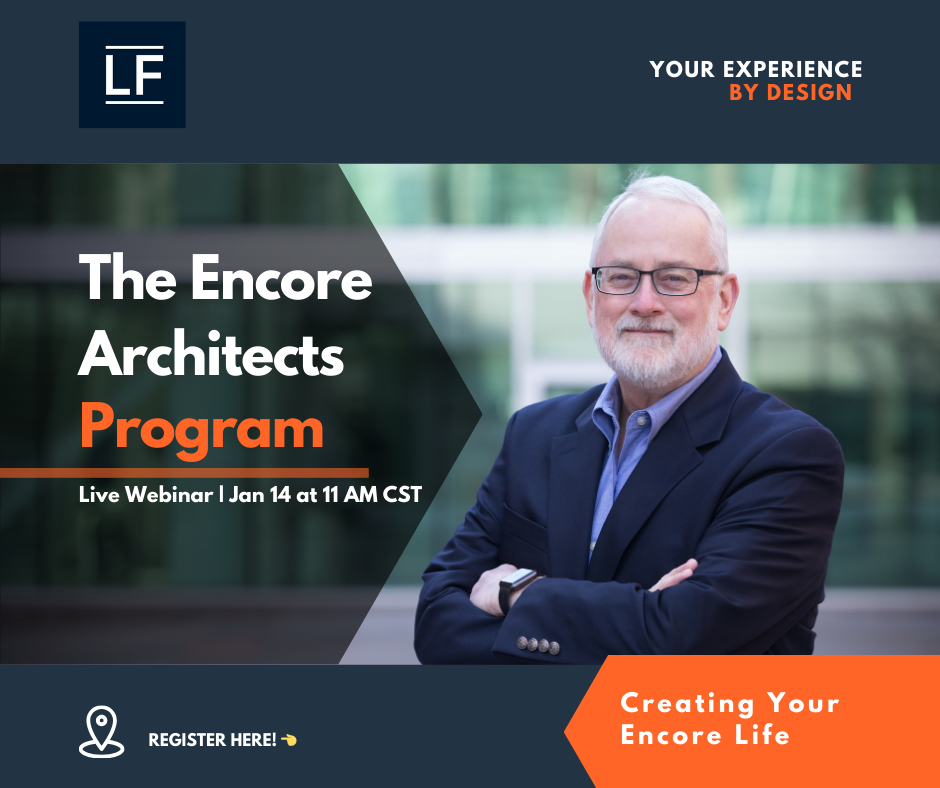
That’s exactly why I’m hosting a free live webinar on Wednesday, January 14 at 11:00 AM CST | 12:00 PM EST.

Why Most People Drift Into Their Next Chapter

Here’s the uncomfortable truth.
Most people don’t design their next chapter. They drift into it.

Not because they lack motivation or ambition, but because no one ever showed them a different way to think about transition. Retirement becomes the default. Consulting becomes the fallback. “I’ll figure it out later” becomes the plan.

But an Encore Life deserves more intention than that.

Designing an Encore, Not Stumbling Into One

This live webinar introduces the core ideas behind The Encore Architects Program, a framework built specifically for experienced professionals who want to use their experience as an advantage, not something to downplay or apologize for.

We’ll talk about what it actually means to design your next chapter, instead of reacting to it.

In the session, we’ll cover:

  • Why drifting is the default, and how to avoid it

  • How to think about an Encore Life as something you actively design

  • The mindset and structure behind the Encore Architects approach

  • What the Encore Architects Founding Cohort includes, and who it’s best suited for

This is not a motivational talk. There are no platitudes here.

It’s a working session designed to help you find clearer language for where you’re headed and decide, with more confidence, what deserves your energy next.

Is This Webinar for You?

This session is for you if:

  • You’ve built a meaningful career and don’t want to simply “wind it down”

  • You know you still have value to offer, but want to be more intentional about how

  • You’re tired of vague advice and ready for a clearer framework

If that sounds familiar, I’d love to have you join us live.

👉 Register here to save your spot 👈
The webinar is free, live, and space is limited.

I’d love to see you there!

Your Encore Career Needs More Than Inspiration. It Needs Implementation.

After 40 years leading teams at John Deere, I learned that good ideas die in the gap between knowing and doing. You can attend every workshop, read every book, and map out your perfect encore career, but without systematic implementation, you’re just planning.

That’s why I built LynnAI Pro.

The Free Version Got You Thinking. Now It’s Time to Build.

The free LynnAI tool helps professionals explore the “what” and “why” of encore careers. Thousands have used it to clarify their thinking, identify their strengths, and understand what’s possible after corporate life. It’s designed for discovery.

LynnAI Pro is designed for execution.

It’s the difference between exploring career transition and actually completing one. Between contemplating your value proposition and having one ready to present. Between thinking about your portfolio career and building it, week by week.

What LynnAI Pro Actually Does

LynnAI Pro combines my decade of coaching methodology—distilled from my own 10-year reinvention plus hundreds of client conversations—with AI-powered implementation support. Here’s what that means in practice:

Weekly Action Plans, Not Generic Advice. You don’t need another pep talk about “finding your purpose.” You need a specific action for this week: who to contact, what to write, where to test your offer. LynnAI Pro delivers timed exercises with clear deliverables.

Framework-Driven Transformation. The tool is built on proven frameworks: G.L.E.A.N. for skill translation, S.T.O.R.Y. for narrative development, and the Offer Ladder methodology for revenue generation. These aren’t theoretical models. They’re structures that produced results for executives transitioning from Fortune 500 roles into portfolio careers.

Progress Tracking That Measures What Matters. LynnAI Pro tracks specific transformation markers: network conversations completed, value propositions tested, revenue streams activated. No vague “journey” language—just quantifiable forward momentum.

On-Demand Coaching Without Calendar Coordination. Access strategic guidance at 11 PM on Tuesday or 6 AM on Sunday. LynnAI Pro doesn’t replace human coaching, but it extends it, giving you implementation support between sessions or when you need immediate clarity on next steps.

Who Gets Results With LynnAI Pro

This tool works for professionals who:

  • Have proven executive or leadership experience but need systematic approaches to career reinvention

  • Want methodology over motivation—you’re past needing inspiration

  • Value evidence-based frameworks that show clear cause-and-effect

  • Need accountability structures that track actual progress, not feelings

  • Prefer strategic guidance they can implement immediately

One client built a portfolio combining board work, mentoring, and part-time teaching—all generating income while maintaining schedule flexibility.

The Implementation Advantage

Here’s what differentiates professionals who successfully design encore careers from those who stay stuck in transition paralysis:

Successful transitioners follow systematic processes. They translate experience into modern contexts. They test offers quickly. They build networks strategically. They track progress quantitatively. They make decisions based on evidence, not emotion.

LynnAI Pro is built specifically to support that implementation mindset.

At 75, I’m still experimenting, still launching, still refining my own portfolio. LynnAI Pro represents my current answer to the question I’ve been working on for a decade: how do experienced professionals systematically design encore careers that generate impact and income?

The answer isn’t more thinking. It’s structured action.

Beyond the Free Tool

If you’ve used the free LynnAI and found value in the exploration, LynnAI Pro is your next step. It takes the clarity you’ve developed and converts it into concrete actions with specific timelines.

This isn’t about finding yourself. You already know who you are. This is about building what comes next—with the same strategic thinking and execution discipline that made you successful in your primary career.

Your decades of accumulated wisdom deserve better than a default retirement. They deserve intentional design. LynnAI Pro provides the systematic framework to build that design.

Ready to move from exploration to execution? LynnAI Pro launches in December alongside structured coaching programs designed to complement the AI tool with human expertise.

Because your encore career shouldn’t just be possible. It should be inevitable.

Sign up for the LynnAI Pro Waitlist

or try the free version here!

How My Team of 19 AI Assistants Helps You Get a Clearer, Faster Encore Plan

If you’re a high-achieving professional in your 50s or 60s, you may be asking a question that’s both exciting and unsettling:

What’s next for me and how do I make it meaningful and financially smart?

I coach executives and professionals who are stepping into an encore chapter, often after decades of success. And here’s something I’ve learned: reinvention isn’t just about choosing a new job or starting a business. It’s about rebuilding identity, designing a life that fits now, and creating income you can feel good about.

To support you at a high level, I don’t rely on willpower and late nights. I use a team of 19 AI assistants (including Claude, ChatGPT, CoachVox, Sintra, Whisper Flow, and Descript) to handle the behind-the-scenes work so our time together stays focused on what matters most: you.

This is not about replacing human coaching. It’s about giving you a coaching experience that’s more organized, more personalized, and more actionable.

What this means for you (the client)

When I use AI well, you get a better outcome, because I can spend less time on admin and more time helping you think clearly and move forward.

Here’s what you can expect.

1) More clarity, faster

You don’t need more information. You need the right structure.

My AI tools help me:

  • Capture your goals, constraints, and preferences clearly

  • Organize patterns I’m hearing across our conversations

  • Turn big, emotional questions into practical next steps

So instead of circling the same doubts for months, you build momentum.

2) A plan that feels personal, not generic

You’ve spent decades building expertise. Your encore path should reflect that.

I use tools like Claude and ChatGPT to help me explore multiple options quickly—then I apply my human judgment and coaching experience to shape what fits you.

That means:

  • More tailored ideas

  • Better language for your story and positioning

  • Clearer decisions about what to pursue (and what to ignore)

3) Your ideas captured, even when you’re busy

Many of my clients have their best insights while walking, traveling, or in the space between meetings.

With Whisper Flow, I can quickly capture and convert spoken insights into usable notes and next steps. The benefit for you: you don’t lose the good stuff.

4) Stronger follow-through between sessions

Reinvention doesn’t happen in a single conversation. It happens in the week after.

My systems help me:

  • Send clearer summaries and action steps

  • Provide templates and prompts so you’re not starting from scratch

  • Keep your progress organized so you can see what’s working

You stay focused, and you don’t have to hold everything in your head.

5) More value without inflating the price

Here’s the part most people don’t see.

To deliver this level of support, many coaches would need a bigger human team—and that cost gets passed on to clients.

Instead, I use a lean, modern setup: my AI team of 19 costs under $1,000/month. That helps me keep my business efficient and invest in the tools and systems that improve your experience—without turning coaching into a luxury reserved for a few.

A quick look at the tools (and what they do for you)

I’ll keep this simple. These tools are not the point—your results are.

  • Claude: helps me create clear frameworks and long-form guidance tailored to your situation

  • ChatGPT: helps me generate options, language, and fast drafts we can refine together

  • CoachVox: helps me keep my coaching approach consistent and aligned with my philosophy

  • Sintra: supports my workflow so your experience feels organized and responsive

  • Whisper Flow: turns voice notes into usable insights and action steps

  • Descript: helps me produce and repurpose audio/video content so you can learn in the format you prefer

What AI can’t do, and why that matters

AI can’t replace the most important parts of this work:

  • The ability to hold space for uncertainty

  • The discernment to challenge you at the right moment

  • The wisdom to help you separate fear from truth

  • The human connection that makes change sustainable

That’s my job.

AI simply makes it easier for me to show up prepared, present, and focused on you.

If you’re considering an encore chapter, START HERE!

If you’re feeling the pull toward something new, here’s a simple place to begin:

  1. Identify what you’re no longer willing to do

  2. Name what you want more of (impact, freedom, income, meaning)

  3. Choose one small experiment you can run in the next 14 days

If you’d like a sounding board, I’m happy to help.

A Next Step

If you want, reply with:

  • What you’re leaving (or considering leaving)

  • What you want your encore chapter to feel like

  • The biggest decision you’re stuck on right now

I’ll share a few thoughtful next steps and a simple way to move forward.

I'm Writing a Book (And It's About Time)

After ten years of living this journey, I'm finally putting it all down on paper.

Not Done Yet: Reimagining Work, Worth, and Wisdom in the Age of AI releases in early 2026.

The Book I Wish I'd Had in 2015

Ten years ago this April, I walked out of John Deere after 40 years. I had the gifts, the pension, the retirement party, all the trappings of a "successful ending."

What I didn't have was a clue about what came next.

Retirement didn't feel like freedom. It felt like eviction from my own life. Within weeks, I went from leading teams and solving problems to... what, exactly? Golf? Travel? Endless leisure that somehow felt more empty than restful?

I wasn't ready to fade into irrelevance. But I also didn't have a roadmap for what reinvention actually looked like at sixty-five.

So I started experimenting. Conference in February. Workshop in July. First consulting contract by December. Each small step built momentum. By my seventies, I had launched a coaching practice, recorded 200+ podcast episodes, created an AI coaching assistant, and mentored with Iowa Venture School and SCORE.

My 60s and 70s didn't become my "retirement years." They became my most innovative decade.

What This Book Is Really About

Not Done Yet is the guide I wish someone had handed me in 2015. A practical blueprint for professionals 55+ who know they're not finished but aren't sure what "next" looks like.

This isn't a book about traditional retirement. It's about reinvention.

It's about turning decades of hard-won experience into encore income. About designing a portfolio life that honors both your expertise and your need for flexibility. About using AI and digital tools to amplify, not replace, your wisdom. About building something meaningful when everyone else assumes you're winding down.

The book weaves together:

  • Real stories from my own messy, imperfect ten-year journey

  • Research-backed frameworks from thought leaders like Chip Conley, Herminia Ibarra, and Cal Newport

  • Practical tools you can use immediately—no corporate ladder required

  • AI strategies specifically designed for seasoned professionals who want to scale their impact

Each chapter opens with a story, delivers insights grounded in data, and closes with action steps you can take this week. No fluff. No platitudes. Just honest guidance from someone who's living it.

Why Now? Why This Book?

Because the old retirement script is broken, and AI is rewriting the rules of work faster than most people realize.

Ten thousand baby boomers turn 65 every day. By 2032, adults 65+ will account for 57% of all workforce growth. We're not a shrinking demographic retiring into obscurity, we're a surging force that needs to figure out how to stay relevant, engaged, and financially secure.

Meanwhile, AI is triggering both fear and opportunity. Will it make us obsolete? Or can we use it to scale our wisdom in ways previous generations never could?

The answer is yes, if we approach it strategically.

That's what this book is about. Helping you turn the corner from "Am I aging out?" to "How do I scale up?"

I Need Your Help With Something

As I finish the manuscript, I keep coming back to one question, and I'm genuinely curious what you'd say.

Here it is:

When you think about your "next chapter" (whether you're 45, 55, 65, or 75), what's the ONE thing that scares you most, and the ONE thing that excites you most?

Drop your answer in the comments. Even if it's just a sentence or two.

I'm asking because your honest reflections will help me make sure this book addresses the real questions people are wrestling with, not just the ones I think matter.

And who knows? Your answer might end up shaping the final chapter.

What Happens Next

The book releases in early 2026. Between now and then, I'll be sharing excerpts, frameworks, and stories from the manuscript right here on the blog and through my newsletter.

This book is a decade in the making, but honestly, I'm just getting started.

So let me ask again: What scares you most about your next chapter? And what excites you most?

I'm listening.

Encore Life Coach Host of Creating Your Encore Life Podcast Creator of LynnAI

P.S. If you know someone who's wrestling with what comes after their "main career," would you share this with them? This message needs to reach the people who are ready to hear it.

Slow Productivity: The Secret Advantage of Your Second Act

For most of your career, productivity meant output. The more you produced, the more valuable you appeared. Long hours, endless meetings, and packed calendars were badges of honor. But somewhere between the late nights and the promotions, that old formula starts to break down.

In your second act, your body whispers for rest, your mind craves depth, and your heart wants purpose—not just performance. You realize the old rules of success won’t build the future you want. Running faster won’t get you where you actually want to go.

That’s where slow productivity begins.

It isn’t about laziness or withdrawal. It’s about focus, craftsmanship, and creating things that last. In an age obsessed with speed, attention becomes your rarest and most valuable currency. When you give your full focus to fewer, better projects, your work carries a weight that busyness can’t buy.

Attention Is the Real Edge

Every ping, email, and headline competes for your attention. Protecting it is an act of rebellion—and leadership. In a world of distraction, your ability to be present is what sets you apart. Clients, audiences, and collaborators can feel when your work is crafted with care rather than rushed through in a blur.

Charles Darwin took over twenty years to publish On the Origin of Species. In today’s culture, he might have been dismissed as slow or unproductive. Yet it was his deliberate pace—the reflection, the testing, the iteration—that gave his ideas staying power. Depth creates durability.

Research backs this up. Gallup found that 76% of workers experience burnout at least sometimes, and professionals in their 50s and 60s feel it more acutely. Studies by the American Psychological Association show that switching tasks can drain up to 40% of effective productivity. For encore professionals, that loss of focus isn’t just inefficient—it’s costly. It erodes the wisdom and clarity that make you valuable.

Why the Old Model Fails

Old habits die hard. Many encore professionals drag corporate reflexes into their new season: saying yes to everything, overloading their calendars, equating busyness with worth. But that model doesn’t scale anymore.

Overwork leads to fatigue, erodes creativity, and lowers quality. Clients sense distraction. Opportunities stall. The cruel paradox? Saying yes to everything often results in earning less—and enjoying nothing.

When the body rebels and the spark dims, it’s easy to mistake exhaustion for irrelevance. But the truth is simple: attention, not age, is what determines your vitality.

What to Do Instead

Slow productivity is about designing work around depth, not volume. Choose the two or three projects that align most deeply with your purpose and give them your full presence.

As Cal Newport writes, “Do fewer things. Work at a natural pace. Obsess over quality.”

  • Do fewer things: Select three priorities each quarter and eliminate the rest.

  • Work at a natural pace: Protect 90–120 minutes of deep, uninterrupted work each day.

  • Obsess over quality: Excellence builds reputation, and reputation creates demand.

Design Your Seasons

Nature doesn’t bloom year-round and neither should you. Structure your year into seasons:

  • Create: Build or launch something new.

  • Contribute: Teach, coach, or share your expertise.

  • Reflect: Review what’s working and refine.

  • Recover: Rest deeply and reconnect.

Rest isn’t wasted time, it’s productive space. Your brain needs it to integrate learning and spark insight.

Reclaim Time Affluence

Freedom in your second act isn’t about doing nothing; it’s about owning your time. White space on the calendar isn’t a luxury, it’s a strategic advantage. Time blocking and batching tasks protect focus. “Stop doing” lists reclaim energy.

Every no makes room for a more meaningful yes.

The Courage to Slow Down

It takes nerve to resist the culture of speed. You may feel guilty at first, as if you’re stepping back. But you’re not retreating, you’re refining. The professionals who thrive in their encore careers aren’t the ones doing the most; they’re the ones doing what matters most, with care and clarity.

Presence is the new productivity.

So take a hard look at your commitments. Trim what doesn’t align. Anchor each week with one big thing that truly matters. Protect your deep work hours like sacred ground. And measure progress not by how much you do, but by how deeply you contribute.

Because this next chapter isn’t about proving you can still keep up. It’s about proving how powerfully you can slow down, and still lead.

Slow Productivity: The Secret Advantage of Your Second Act

For most of your career, productivity meant output. The more you produced, the more valuable you appeared. Long hours, endless meetings, and packed calendars were badges of honor. But somewhere between the late nights and the promotions, that old formula starts to break down.

In your second act, your body whispers for rest, your mind craves depth, and your heart wants purpose, not just performance. You realize the old rules of success won’t build the future you want. Running faster won’t get you where you actually want to go.

That’s where slow productivity begins.

It isn’t about laziness or withdrawal. It’s about focus, craftsmanship, and creating things that last. In an age obsessed with speed, attention becomes your rarest and most valuable currency. When you give your full focus to fewer, better projects, your work carries a weight that busyness can’t buy.

Attention Is the Real Edge

Every ping, email, and headline competes for your attention. Protecting it is an act of rebellion, and leadership. In a world of distraction, your ability to be present is what sets you apart. Clients, audiences, and collaborators can feel when your work is crafted with care rather than rushed through in a blur.

Charles Darwin took over twenty years to publish On the Origin of Species. In today’s culture, he might have been dismissed as slow or unproductive. Yet it was his deliberate pace, the reflection, the testing, the iteration, that gave his ideas staying power. Depth creates durability.

Research backs this up. Gallup found that 76% of workers experience burnout at least sometimes, and professionals in their 50s and 60s feel it more acutely. Studies by the American Psychological Association show that switching tasks can drain up to 40% of effective productivity. For encore professionals, that loss of focus isn’t just inefficient, it’s costly. It erodes the wisdom and clarity that make you valuable.

Why the Old Model Fails

Old habits die hard. Many encore professionals drag corporate reflexes into their new season: saying yes to everything, overloading their calendars, equating busyness with worth. But that model doesn’t scale anymore.

Overwork leads to fatigue, erodes creativity, and lowers quality. Clients sense distraction. Opportunities stall. The cruel paradox? Saying yes to everything often results in earning less, and enjoying nothing.

When the body rebels and the spark dims, it’s easy to mistake exhaustion for irrelevance. But the truth is simple: attention, not age, is what determines your vitality.

What to Do Instead

Slow productivity is about designing work around depth, not volume. Choose the two or three projects that align most deeply with your purpose and give them your full presence.

As Cal Newport writes, “Do fewer things. Work at a natural pace. Obsess over quality.”

  • Do fewer things: Select three priorities each quarter and eliminate the rest.

  • Work at a natural pace: Protect 90–120 minutes of deep, uninterrupted work each day.

  • Obsess over quality: Excellence builds reputation, and reputation creates demand.

Design Your Seasons

Nature doesn’t bloom year-round, and neither should you. Structure your year into seasons:

  • Create: Build or launch something new.

  • Contribute: Teach, coach, or share your expertise.

  • Reflect: Review what’s working and refine.

  • Recover: Rest deeply and reconnect.

Rest isn’t wasted time, it’s productive space. Your brain needs it to integrate learning and spark insight.

Reclaim Time Affluence

Freedom in your second act isn’t about doing nothing; it’s about owning your time. White space on the calendar isn’t a luxury, it’s a strategic advantage. Time blocking and batching tasks protect focus. “Stop doing” lists reclaim energy.

Every no makes room for a more meaningful yes.

The Courage to Slow Down

It takes nerve to resist the culture of speed. You may feel guilty at first, as if you’re stepping back. But you’re not retreating, you’re refining. The professionals who thrive in their encore careers aren’t the ones doing the most; they’re the ones doing what matters most, with care and clarity.

Presence is the new productivity.

So take a hard look at your commitments. Trim what doesn’t align. Anchor each week with one big thing that truly matters. Protect your deep work hours like sacred ground. And measure progress not by how much you do, but by how deeply you contribute.

Because this next chapter isn’t about proving you can still keep up. It’s about proving how powerfully you can slow down, and still lead.

10 Rules for Navigating Your Encore Life

For decades, your professional identity may have been wrapped in titles, responsibilities, and achievements. The corner office. The strategic wins. The recognition at annual meetings. But when that chapter ends, you’re left with an open question: Who am I now, and what’s next?

Too often, society hands us a flat, outdated script: retire, relax, play golf, fade into the background. But high achievers like you know that story doesn’t fit. You didn’t spend a lifetime solving complex problems and leading others just to retreat into irrelevance.

The truth is this: retirement isn’t a finish line. It’s a doorway. The encore stage of life, your next 20, 30, even 40 years can be your most intentional, meaningful, and creative season yet. But to walk through that doorway with confidence, you’ll need a new set of rules.

Here are 10 rules for navigating your encore life. Each is an invitation, a challenge, and a permission slip to step boldly into reinvention.

1. Your identity isn’t your former title.

For years, your title answered the question: What do you do? But now the real question is: Who are you becoming? This stage of life is about expanding your identity, not shrinking it. You are more than a résumé. Your leadership, wisdom, and lived experiences are assets that don’t expire.

2. Your next 30 years deserve intention.

You spent decades planning careers, strategies, and investments. Why not approach the next 30 years with the same level of care? Without intention, it’s easy to drift. With intention, you create a chapter that is aligned with your values, your purpose, and your joy.

3. Starting over isn’t failure, it’s evolution.

Too many people fear the blank page. They tell themselves they’re “too old” to begin again. But starting over isn’t about erasing your past, it’s about building on it. Think of it as upgrading, not downgrading. Evolution is proof of courage.

4. Community beats isolation every time.

When you leave corporate life, you also leave an ecosystem of relationships. The danger? Isolation. The opportunity? Rebuilding a community that energizes you. Surround yourself with fellow pioneers who are navigating similar transitions. Iron sharpens iron.

5. The messy middle of transition is normal.

Between the career you left behind and the future you’re creating, there will be an in-between space. It’s disorienting, even uncomfortable. But it’s also fertile ground. The messy middle is where reinvention takes root. Don’t rush through it, use it.

6. Small experiments lead to big discoveries.

You don’t need a perfect five-year plan. You need small steps. Try a project, launch a pilot, write a draft, test an idea. Each experiment is a data point, not a verdict. Momentum comes from motion, not perfection.

7. Your experience has value in new markets.

The marketplace may not be looking for your old title, but it is looking for your skills, insights, and wisdom. Think beyond the narrow lane of your past industry. Your value may lie in advising, mentoring, creating, or teaching in spaces you’ve never considered.

8. Financial planning includes purpose planning.

Yes, you need to know your numbers. But spreadsheets won’t give you meaning. Financial security without a sense of purpose still leads to emptiness. Plan for impact, joy, and contribution alongside dollars and cents.

9. Tech skills can be learned, no matter your age.

You are not “too old” for technology. In fact, today’s tools give you leverage you’ve never had before. Whether it’s AI, digital marketing, or online business platforms, you can learn what you need, quickly. Don’t let fear of tech keep you small.

10. Learning new skills at 60+ is courage, not desperation.

When you sign up for a course, join a mastermind, or embrace new tools, you’re not scrambling to stay relevant, you’re demonstrating courage. Reinvention is not about clinging to the past; it’s about leaning into the future. Every new skill is a signal: I’m not done yet.

The Invitation

The encore stage of life isn’t about winding down—it’s about reinventing. These 10 rules aren’t meant to overwhelm you. They’re meant to anchor you. They give you a framework to move forward with clarity and confidence.

The question is: Which rule do you need to embrace today?

Maybe it’s giving yourself permission to step outside the shadow of your old title. Maybe it’s reconnecting with a community of peers. Maybe it’s finally leaning into the messy middle instead of trying to escape it.

Whatever it is, remember this: you’re not retiring. You’re pioneering.

A Final Word

When I work with clients navigating this transition, one truth stands out again and again: the people who thrive aren’t the ones who have all the answers. They’re the ones who are willing to experiment, to learn, to connect, and to embrace the identity of “pioneer.”

Your encore life can be a season of purpose, impact, and freedom. But only if you claim it.

So—what’s your next step?

And if you’re ready for more personal support, I invite you to try Lynn AI—your free, private guide to navigating change and clarifying your next steps.

Explore Lynn AI here:​ ​​lynnfriesth.com/lynn-ai​

You’re Never Too Old to Learn, Lead, or Launch

There’s a subtle message baked into the modern workplace and startup culture: if you’re not under 40 and moving at lightning speed, you’re falling behind.

It’s nonsense.

In fact, it’s worse than nonsense, it’s dangerous. Because it convinces some of the most capable, experienced, and thoughtful leaders to step back just when they’re most equipped to step up.

Let’s set the record straight.

Experience isn’t a liability. It’s a competitive advantage.

If you’re reading this, chances are you’ve spent decades solving real problems, managing complexity, and building relationships that matter. You’ve weathered downturns, mentored teams, led transformations, and made calls that couldn’t be Googled.

That’s not something to retire from. That’s something to reinvest.

Too often, professionals in their 50s, 60s, or beyond are told to “slow down,” “make room,” or “just enjoy retirement.” But here’s what I’ve learned, both personally and from coaching others in the same chapter of life:

The desire to create doesn’t retire.

What you have now that you didn’t have at 35 is pattern recognition. Wisdom. Strategic patience. You don’t get rattled by headlines or distracted by fads. You know what works because you’ve seen what doesn’t.

That’s exactly what the world needs.

You’re Not Too Old, You’re Right on Time

Let me be blunt: you are not too old to learn, lead, or launch.

  • To Learn: The myth that neuroplasticity disappears with age is false. In fact, older adults often learn faster when the material is meaningful. Whether it’s mastering AI tools or building a personal brand online, you can absolutely do it, and likely with more focus than your younger self.

  • To Lead: Leadership today isn’t about being the loudest voice in the room, it’s about offering clarity in chaos. If you’ve been in the trenches, your calm is your currency. Your ability to mentor and guide others through uncertainty is more valuable than ever.

  • To Launch: Some of the most successful entrepreneurs and creatives started after 50. Why? Because they weren’t guessing anymore. They were finally building what only they could uniquely build. Starting something new isn’t reckless, it’s responsible, if you’re doing it with purpose and perspective.

The Real Risk? Staying Stagnant

If there’s one thing I see derail post-career professionals more than anything else, it’s not failure—it’s stagnation.

The calendar opens up. The urgency fades. And slowly, the spark dims. Not because they don’t care, but because they’ve lost context. They’ve lost the sense of being in the game.

That’s why I created the Encore Life Framework. It’s not just about starting a business or getting active on LinkedIn. It’s about rediscovering who you are when the titles are gone but your impact is still unfolding.

The truth is, high achievers don’t age out, they evolve. And reinvention is not just possible, it’s powerful, when guided by experience.

So Let Me Ask You:

  • What idea have you been sitting on that you know could make a difference?

  • What’s one skill you’ve been avoiding that could open new doors if you just gave it a chance?

  • Who could benefit right now from your leadership, your insight, or your encouragement?

Don’t underestimate yourself.

This chapter of life isn’t your “afterthought.” It’s your advantage. You bring perspective others don’t. You see the long game. And you have nothing left to prove, only something meaningful to build.

Let’s stop pretending that age is a barrier.

It’s not a barrier, it’s your edge.

If you’re ready to learn, lead, or launch something bold in your next chapter, I invite you to explore LynnAI, my free 24/7 coaching tool that helps you plan, reflect, and take action. Or reach out to me directly if you’re ready to go deeper.

You’re not done yet. You’re just getting started.

Lynn

Retirement Isn’t the Finish Line—It’s a Scene Change 🎭

We were raised on a script: Work hard. Retire. Relax.

But maybe that script wasn’t written for you.

Because you’re not looking to fade out. You’re not done growing, building, or contributing. The applause might have paused, but the show isn’t over. You’re simply between acts.

For high achievers like you, retirement isn’t a destination—it’s a doorway. Not into rest, but into relevance. Not into winding down, but into realignment.

Here’s the truth: The real threat isn’t aging. It’s stagnation.

Let’s challenge the old assumptions. Let’s rewrite Act II with intention. Here’s how to begin:

🔨 Step 1: Replace Retirement With Realignment

Retirement says “stop.” Realignment says “shift.” This isn’t about stepping down. It’s about stepping differently.

Now is the time to ask: Where can your experience create the most value—on your terms? Advisory roles, creative projects, mentoring, consulting, or launching that solo venture you shelved years ago.

You’re not leaving the game. You’re changing positions.

🔥 Step 2: Follow the Restless Energy

That whisper in the back of your mind? The idea you can’t shake? The challenge you keep thinking about?

That’s not a distraction. It’s a signal.

Maybe it’s:

  • A note in your journal about a business idea

  • A former colleague asking for advice (again)

  • A social issue that keeps pulling at your heart

Whatever it is, lean in. That tug is your intuition reminding you: you still have more to give.

🚫 Step 3: Bust the Myth of Aging Out

Let’s be clear—leadership doesn’t have an expiration date.

Experience isn’t something to downplay. It’s compound interest. The more you’ve seen, built, led, and failed through, the sharper your lens becomes.

So if someone tells you you’re “too experienced,” take that as confirmation you’re in the right room—but it’s time to choose a different seat.

Don’t let ageist norms define your story. Define it yourself.

👤 Step 4: Shift From Title to Identity

For decades, your identity may have been tightly wrapped around your title. VP. Director. Consultant. CEO.

Now, you get to ask a different question: Who am I when the titles are gone?

This isn’t erasure. It’s evolution. You’re not losing your identity—you’re clarifying it.

Your new chapter is built not on a resume, but on a mission. One rooted in values, purpose, and the freedom to say “this is what matters to me now.”

🌅 Step 5: Treat This as a Renaissance, Not a Retreat

This isn’t the end of the road. It’s the start of your encore.

The audience may have changed. The spotlight may feel different. But the stage is still yours.

You’ve earned the freedom to build something bold. Something fulfilling. Something that’s entirely yours.

Don’t retreat. Reimagine. Don’t fade. Flourish. This is your renaissance.

Remember this: You don’t need permission to start again. You only need to listen to the part of you that knows you’re not done yet.

The encore life isn’t a consolation prize. It’s the most intentional act of your career.

And you’re right on cue.

✳️ P.S. Ready to explore what your encore could look like? ​Lynn AI​ is here 24/7 to help you clarify your next step. Try it out today.

Overwhelmed by New Tools? Here’s How to Stay Focused and Move Forward

In today’s digital world, it seems like there’s a new tool or platform launching every week. AI, automation, content schedulers, CRM systems, video editors, personal branding dashboards—you name it. If you’re building your encore career, the pressure to “keep up” can feel overwhelming.

But here’s the truth: you don’t need every tool. You need the right tools—and only a few of them.

This isn’t about becoming a tech wizard. It’s about staying focused on what matters, using just enough technology to support your work—not derail it.

Let’s talk about how to avoid overwhelm and keep your momentum.

1. Focus on Function, Not Flash

High achievers often default to learning everything before doing anything. But when it comes to tools, that mindset will bury you in complexity. Fancy dashboards and endless tutorials can feel productive—but they’re often distractions.

Start with this question: What am I actually trying to do?

Want to write a weekly newsletter? You don’t need a full-blown marketing automation suite—just a simple email tool like ConvertKit or MailerLite.

Want to post regularly on LinkedIn? You don’t need to master four scheduling platforms. You can post natively or pick one scheduler and stick with it.

Let your goals lead your tool choices—not the other way around.

2. Pick 2–3 Core Tools and Stick With Them

Your encore career doesn’t need 20 logins. In fact, too many tools often means fragmented attention and zero progress.

Here’s a helpful trio for most solopreneurs:

  • A content tool – to create and share your message (like Canva or ChatGPT).

  • A communication tool – to connect with clients or followers (like Zoom, LinkedIn, or ConvertKit).

  • A calendar or task manager – to keep you organized (like Google Calendar or Notion).

That’s it. These three categories can support 90% of your work. Learn just enough to use them effectively. Then move on to doing the work that matters.

3. Clarity Beats Complexity—Always

The temptation to tinker is strong, especially when starting something new. But if you’re constantly learning, comparing, and testing tools, you’re not building momentum. You’re circling the runway.

Every hour spent fiddling with new apps is an hour you’re not connecting with a client, writing a post, recording a video, or building your reputation.

Clarity—knowing what you’re building, who it’s for, and why it matters—is worth more than any automation sequence.

Simplify your setup. Then commit to taking messy action.

4. Your Mindset Is the Real Operating System

You’re not behind.

You’re not “too old for this.”

You’re not supposed to master every new platform.

You’re here to lead with your wisdom. To share your stories. To teach, guide, and create impact in ways that only someone with your experience can.

Tech is your servant, not your master. The tool that matters most? Your mindset.

Instead of asking “What tool do I need?”—ask “What story do I need to tell?” or “What value can I offer today?”

That’s how leaders create movements, not just content.

5. Experiment in Public, Learn in Small Bites

You don’t need to take a course on every tool. You just need to try something small and see what happens.

  • Post one video, not a whole series.

  • Send one email, not a whole campaign.

  • Try one AI prompt, not 50.

Each tiny experiment gives you feedback. Each action sharpens your skills. Each step builds confidence.

You didn’t build your first career in a day. You built it through iteration, curiosity, and showing up. That same mindset works now.

Final Thought

You don’t need more tools—you need more traction.

Choose a few core tools. Learn just enough to take action. Focus on creating, connecting, and showing up. The rest can wait.

You’re not building a tech stack.

You’re building a legacy.

And that starts by doing the next simple thing—today.

Hello, my name is Lynn

Hello, my name is Lynn!

Nine years ago, I walked out of John Deere headquarters for the last time. After 40 years in manufacturing, I shook a few hands, turned in my badge, and stepped into “retirement.”

Or at least, that’s what it was supposed to be.

Instead, I found myself staring at the same question I now hear from so many of my clients:

“What now?”

For four decades, my work defined me. My days were filled with teams, projects, and deadlines. My title told the world who I was. But when the title was gone, I realized something powerful: I had been preparing for the next chapter all along—I just didn’t know it.

So today, as I mark nine years since that transition, I thought it was the right moment to pause, reflect, and reintroduce myself.

Who I Am Today

I’m Lynn Friesth, a Mid-Life Transition Coach.

I help professionals 55 and older navigate the shift from corporate identity to an encore life—one that blends purpose, flexibility, and meaning.

My coaching isn’t about theory. It’s about lived experience. I’ve walked the path. I know the highs, the lows, and the messy middle. And I’ve seen firsthand that this next chapter can be the most fulfilling of all.

Five Things You Might Not Know About Me

  1. Strengths That Stick. I’ve taken StrengthsFinder twice—years apart—and both times my top five were the same: Learner, Input, Ideation, Intellection, Futuristic. Translation? I’m wired to explore, to connect ideas, and to imagine new futures. Reinvention was in my DNA long before I left corporate life.

  2. Family First. I’ve been married to Mary Lee for over 40 years. Together, we raised three kids and now enjoy our one grandchild. They’ve been my anchor through every transition.

  3. The Book Collector. My kids tease me about the hundreds of business books filling my shelves. I can’t help it—I’ve always been fascinated by ideas and strategies. Each book felt like a conversation with a new mentor.

  4. Process, Not Execution. Through reflection, I discovered my true strength wasn’t in executing day-to-day operations. It was in reimagining processes, asking “why,” and finding ways to make things better. That curiosity became the foundation of my encore career.

  5. Encore Believer. I don’t see this stage of life as winding down. I believe your encore career—the one after corporate life—can be your best chapter yet. A chapter fueled by wisdom, perspective, and the freedom to design work around your values.

Why This Matters

It’s tempting to think that life after corporate is simply about slowing down. But if you’re reading this, I know you’re wired differently. You’re not done yet.

Here’s what I’ve learned:

  • Who you become after corporate life matters more than any title you held.

  • The messy middle of transition—the uncertainty, the experiments, the self-doubt—is not a sign of failure. It’s the path.

  • Reinvention isn’t about erasing your past. It’s about reimagining your future, using everything you’ve already learned.

I’ve guided many professionals through this stage. Some launched consultancies. Some started creative businesses. Others leaned into mentoring, volunteering, or advisory work. The form varies—but the outcome is the same: a renewed sense of identity and impact.

Lessons From My Own Transition

Looking back, three lessons stand out from my journey:

  1. Don’t Rush Clarity. I wanted answers right away. But clarity came through experimentation—trying, failing, and adjusting. Your encore career doesn’t arrive fully formed. It unfolds.

  2. Stay Curious. At 65, I had to be a beginner again. I learned new technologies, explored unfamiliar industries, and asked for help. Curiosity wasn’t optional—it was oxygen.

  3. Community Matters. Transition can feel isolating, especially when peers stay in corporate roles. Finding a community of others asking “what’s next?” was essential. It reminded me I wasn’t alone.

Where I Am Now

Today, I coach executives and professionals who are stepping out of long corporate careers. They’re often wrestling with questions like:

  • “Who am I without my title?”

  • “What kind of work matters to me now?”

  • “Can I really learn new skills at this stage?”

  • “How do I build something meaningful—and still make it practical?”

I don’t hand out cookie-cutter answers. Instead, I guide people to rediscover their strengths, clarify their vision, and design an encore life that reflects who they are now—not just who they used to be.

An Invitation

So, time for the question to turn back to you:

👉 What’s the biggest challenge you’re facing in your transition?

Reply and let me know.

Your story matters. And whether you’re just stepping away from corporate life, or you’ve been navigating the messy middle for years, I want you to know something:

You’re not starting over. You’re starting forward.

And your encore life has the potential to be your most impactful chapter yet.

Until next time,

Lynn

P.S. If you’re feeling stuck in your own “What now?” moment, let’s talk. Coaching isn’t about giving you answers—it’s about helping you find clarity, momentum, and confidence for what comes next.

What These 4 Books Teach Us About Building Your Next Chapter

If you're in your 50s or 60s and feeling the itch for something new, you're not alone — and you're not behind. You’re right on time for a powerful career reinvention.

More executives and professionals are trading traditional roles for autonomy, purpose, and flexibility. They're launching coaching businesses, advisory services, creative ventures — or all three. But how do you design a career that fits this new phase of life?

These four books offer powerful guidance:

1. The Portfolio Life by Christina Wallace

Lesson: Diversify Your Work, Like You Diversify Investments

Wallace encourages us to break out of the “one job” mindset. Instead of relying on a single full-time role, why not build a career portfolio — a mix of roles that reflect your skills, interests, and values?

You might consult part-time, teach on the side, write a book, or start a podcast. This approach spreads risk, keeps you energized, and creates income from multiple sources.

For mid-life professionals: You don’t need to bet everything on one path. You’ve earned the right to design a flexible, purpose-driven portfolio.

👉 Try this: Make a list of things you can do, things you want to do, and things people ask you for. Where do they overlap?

2. One Person / Multiple Careers by Marci Alboher

Lesson: You Don’t Have to Choose Just One Identity

Alboher coined the term “slash career” — like lawyer/coach or executive/speaker. It’s a liberating concept, especially if you're navigating the loss of identity that can come after leaving a long corporate role.

Rather than trying to shrink into one box, this book encourages you to embrace all of your interests and experiences.

For mid-life professionals: You’re not defined by your past job title. You can combine your passions and experience into a unique personal brand.

👉 Try this: On your LinkedIn profile or bio, experiment with listing your multiple roles. Let people see your range — it's a strength, not a liability.

3. The Million-Dollar, One-Person Business by Elaine Pofeldt

Lesson: You Can Build Big Without a Big Team

Pofeldt profiles entrepreneurs who built six- and seven-figure businesses entirely on their own. No employees. No office. Just smart systems, a clear offer, and a commitment to doing meaningful work.

Whether it’s online education, e-commerce, consulting, or services, the key is to focus and scale intelligently.

For mid-life professionals: You don’t have to build an empire. You can create freedom, income, and impact — solo.

👉 Try this: What service or solution do people often ask you for? Could you offer it as a productized package, course, or subscription?

4. Company of One by Paul Jarvis

Lesson: Growth Isn’t the Goal — Freedom Is

Jarvis flips the traditional business script. Instead of chasing constant growth, ask: What’s enough? What if you optimized for time, autonomy, and creativity instead of scale?

This mindset is perfect for professionals in mid-life who’ve already proven themselves and now want to do work on their own terms.

For mid-life professionals: Staying small might be the smartest — and most satisfying — strategy you’ve ever tried.

👉 Try this: Define what “enough” means to you. Not just financially, but in time, energy, and impact. Let that become your business plan.

Final Thoughts: You’re Not Starting Over — You’re Starting Smart

What these four books all have in common is this: They redefine success for people like us — people with experience, wisdom, and the desire to do work that matters without burning out.

Whether you want to consult, coach, create content, or launch your own service business, you can design a career that works for your life — not the other way around.

You don’t need a big team. You don’t need a new degree. You just need clarity, curiosity, and the courage to begin.

The Future Belongs to the Self-Directed

The Future Belongs to the Self-Directed

For years, many of us succeeded by following a well-defined path. We advanced through roles, managed teams, delivered results, and met expectations. The system worked, until it didn’t.

Today, those old structures are dissolving. The job titles matter less. The playbook is outdated. And what once felt like certainty now feels like silence.

But this isn’t an ending. It’s an invitation.

We are entering a new season where value isn’t assigned by a company. It’s shaped by how we choose to show up. In this emerging landscape, those who are self-directed have the edge.

You Get to Set the Course

If you’ve found yourself wondering what comes next, you’re not alone. The transition from corporate life can feel disorienting. But it also holds incredible potential.

Being self-directed means you no longer wait to be chosen. You no longer require approval to explore a new idea or pursue a new direction. You choose what to focus on. You define your purpose. You decide who you want to serve and how.

This isn’t a theory. It’s a practical shift. One that gives you the freedom to put your experience to work in more personal, purposeful ways.

Designing Your Own Framework

Being self-directed doesn’t mean drifting without focus. It means replacing external structure with intentional design.

Here are some ways this might take shape:

  • You start a solo consulting practice, helping organizations with the very challenges you’ve solved for years.

  • You become a mentor or advisor, passing on hard-won lessons to emerging leaders.

  • You dive into writing, teaching, or launching a passion project that reflects your values.

This is not retirement. It’s reinvention. It’s the chance to work on what matters, at a rhythm that fits your life now.

Clearing Out the Noise

Of course, stepping away from long-held routines can feel uncertain. Many hesitate because they’re used to operating within clear boundaries. Others worry they’re too late to start something new.

Neither is true.

What you have now is something you didn’t have at the start of your career: clarity, perspective, and confidence rooted in lived experience. That is a powerful combination.

You don’t need to prove your worth. You need to apply it with intention.

Being self-directed doesn’t mean going it alone. It means choosing your collaborators, your partners, and your direction. It means asking what you want this next chapter to look like—and then beginning to shape it.

What Comes Next

If you feel a quiet pull to create, contribute, or explore, pay attention. That instinct is worth trusting.

You may not have a formal title anymore. But you do have a mission.

You don’t need another company to offer you a role. You need to define the role you want to play.

You’ve already navigated complexity, led through change, and solved big problems. Now is the time to take that same skill set and apply it on your terms.

You are not behind. You are not starting over. You are ready to begin again—with wisdom and with purpose.

If you’re looking for a guide on this path, I’ve created a digital resource called LynnAI to support you. It’s built specifically to help experienced professionals think through next steps, get unstuck, and move forward with clarity.

You can explore LynnAI here.